Madrid, 19 de noviembre del 2020.- El famoso gurú Daniel Goleman escribe este pasaje en su libro “Inteligencia Social” (Editorial Kairós, Octubre 2006), en la sección “La Economía Emocional”, Página 26:
“Cierto día que llegaba con retraso a una reunión en el centro de Manhattan y, que andaba buscando un atajo, me mentí en el patio interior de un rascacielos, con la intención de salir por una puerta que había divisado al otro lado y adelantar así unos minutos. Pero, en el mismo momento en que entré en el vestíbulo del edificio y me encontré ante una fila de ascensores, apareció súbitamente un guarda jurado que, moviendo los brazos me gritó: “¡Usted no puede estar aquí¡”.¿Por qué? -pregunté, sorprendido.
¡Porque ésta es una propiedad privada¡. ¡Es una propiedad privada¡ -gritó, notablemente agitado.
Entonces me di cuenta de que había entrado en una zona de acceso restringido que no estaba adecuadamente señalizada.
No me hubiera equivocado -sugerí en un débil intento de infundir un poco de razón- si en la puerta hubiera una señal que dijese “Prohibida la entrada”.
Pero mi comentario no sirvió de nada, sino que le enfureció todavía más. ¡Fuera¡, ¡Fuera¡ -gritó. Entonces me marché, inquieto, mientras su ira siguió reverberando en mis tripas durante varias calles.
Cuando una persona vomita sobre otra sus sentimientos negativos -mediante explosiones de ira, amenazas u otras muestras de indignación o desprecio- activa en ella los mismos circuitos por lo que discurren estas inquietantes emociones, un hecho cuya consecuencia neurológica consiste en el contagio de esas mismas emociones. Porque hay que decir que las emociones intensas constituyen el equivalente neuronal de un resfriado y se “contagian” con la misma facilidad con lo que hace un rinovirus”.
2020 ha sido un año intensamente emocional debido a la pandemia mundial del COVID-19. Gran parte de este horrible ejercicio lo hemos vivido en nuestros hogares, teletrabajando o volviendo a las empresas después del verano. Precisamente en las compañías, los CEOs hemos tenido que mantener a raya nuestras emociones para salvar las cuentas anuales. Y aquí el talento humano y profesional, las trayectorias, la experiencia han sido el mejor salvoconducto.
¿Qué Directivos necesitan hoy las grandes multinacionales, las pequeñas y medianas empresas?
Los Directivos con más de 50 años y con acreditada experiencia laboral son la opción idónea para cualquier tipo de empresa hoy en día. Somos el aval más eficiente para enfrentarnos a una pandemia mundial sin horizonte de finalización. Para enfrentarnos a una situación económica inédita en los últimos 100 años. Para enfrentarnos a las peores emociones del ser humano. Para enfrentarnos a los mayores desafíos tecnológicos que van a acelerarse en los próximos 5 años: Internet de las Cosas, Realidad Aumentada, Blockchain, Machine Learning, Big Data, Electrificación y Coches Autónomos, etc.
Por supuesto, dirigir empresas y tener más de 50 años no puede significar, en ningún caso, una excedencia o una jubilación anticipada. De hecho, en Europa las jubilaciones se están intentando retrasar por encima de los 65 años. Por lo tanto, un Directivo se encuentra en su mejor momento a partir de los 50 años.
Tom Peters decía: “La excelencia no es una meta a largo plazo, sino lo que hagas en los próximos cinco minutos”. El Directivo, a partir de los 50 años, sabe perfectamente lo que hay que hacer hoy y mañana. Y siguiendo con Tom Peters y sus grandes lecciones en el liderazgo empresarial:
- La excelencia no es una aspiración, la excelencia es lo que haces en los próximos cinco minutos.
- Los líderes no crean seguidores, crean más líderes.
- Lo más difícil en el mundo no es que la gente acepte nuevas ideas, sino hacerles olvidar las viejas.
- La fórmula mágica que han descubierto los negocios exitosos es tratar a sus clientes como invitados y a sus empleados como personas.
- Lo que se mide, se hace, pero no todas las acciones que influyen positivamente en nuestro entorno se puede medir.
- En el largo plazo, serás recordado por la calidad de tu trabajo, no por la cantidad de tu trabajo. Nadie evalúa a Picasso solo por el número de cuadros que produjo.
- Si aparece una ventana de oportunidad, no bajes la persiana.
- La innovación solo es posible si se comparte la información, en lugar de acumularla.
- Si amas a tu compañía y amas lo que haces servirás mejor a tus clientes.
- Escucha mientras puedas, para que puedas liderar cuando debas.
- Los líderes que trabajan de forma más eficaz nunca dicen «yo». Ellos dicen «nosotros» y piensan «equipo».
- Los mejores líderes son los que mejor toman notas, los que mejor preguntan y los que mejor aprenden.
- Una mejora del 1% en mil cosas es mejor que una mejora del 1.000% en una sola cosa.
- Nunca te duermas en los laureles. Los laureles de hoy son el abono de mañana.
- Los ganadores deben aprender a disfrutar del cambio con la misma energía con la que se resistieron a él en el pasado.
- Solo aquellos que se forman constantemente tendrán una oportunidad de seguir trabajando en los próximos años.
- La buena noticia es que todo el mundo tiene la oportunidad de sobresalir. Todos tienen la oportunidad de aprender, mejorar y desarrollar sus habilidades. Todos tienen la oportunidad de ser una marca digna de mención.
- La diferencia entre la grandeza y la mediocridad es, sobre todo, tener la imaginación y el celo para reinventarse a diario.
- ¿Cuál es mi estrategia personal para las próximas 10 horas? decidir con quién voy a hablar o qué puedo aprender.
- Lo que decides no hacer es probablemente más importante que lo que decides hacer. Si no es la excelencia ¿entonces el qué? si no soy excelente ahora ¿entonces cuándo?.
- La carrera de un líder dependerá de cómo gestione uno o dos eventos críticos que nadie podría haber anticipado.
Esta selección ha sido publicada por el Instituto de Estudios Bursátiles (IEB)
#BestCEOs
- He rise of AI-Agent networks on the interconnected job site
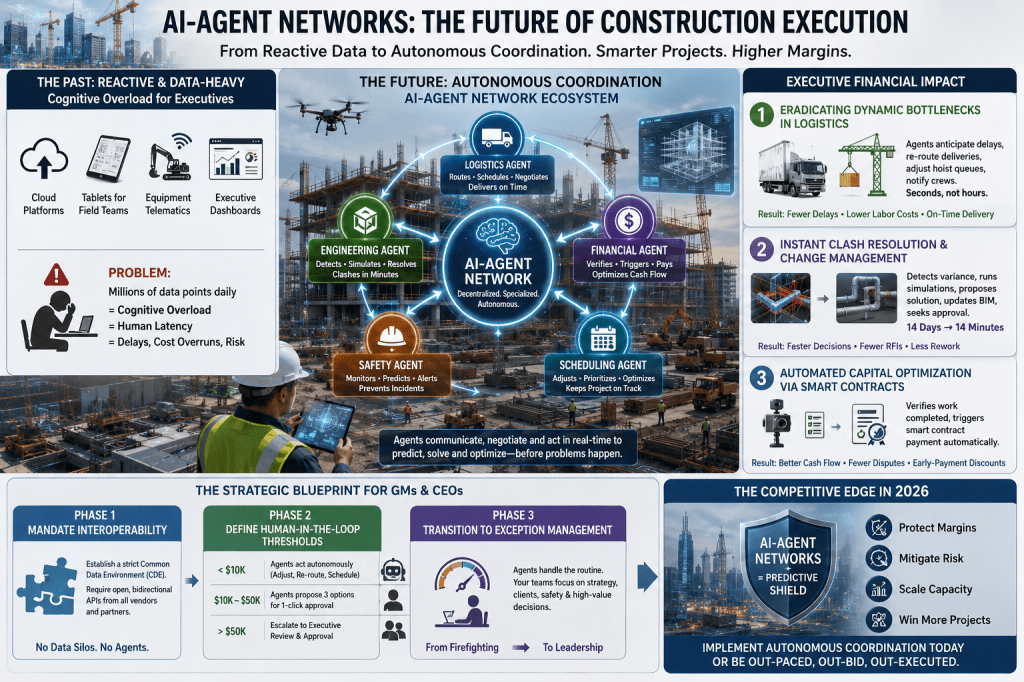 Houston, August 28, 2026.- For the past decade, digitalization in the construction sector has followed a predictable roadmap: deploy a cloud-based project management platform, equip field teams with tablets, connect heavy machinery via basic telematics, and aggregate the resulting data into an executive dashboard. While this centralized approach improved visibility, it introduced a new bottleneck for… Read more: He rise of AI-Agent networks on the interconnected job site
 - Solving the 2026 Talent Deficit
 Houston, July 7, 2026.- The construction industry is facing a quiet crisis, and it is happening at the top of the organizational chart. For years, General Managers and Chief Executives across the Americas have treated the “labor shortage” as a temporary roadblock—a cyclical challenge that would resolve itself with the next economic shift. It is now 2026,… Read more: Solving the 2026 Talent Deficit
 - The Vertical Nervous System: Transforming Construction Hoists from Cost Centers to Data Assets
 Houston, 15 June 2026.– The conversation around vertical logistics was relegated to the margins of the budget, treated as a necessary but burdensome cost center—a line item where the primary objective was to minimize rental rates or CAPEX. However, as we navigate the complexities of 2026, the paradigm has undergone a radical shift where the hoist… Read more: The Vertical Nervous System: Transforming Construction Hoists from Cost Centers to Data Assets
 - The Great Re-Shoring: Why Monterrey is the New Chicago
 Houston, 14 May 2026.– For decades, if you wanted to see the industrial heartbeat of North America, you went to Chicago. The Windy City was the undisputed king of logistics, manufacturing, and vertical growth. But as we navigate the first half of 2026, the compass has shifted decisively south. Today, that same industrial electricity is vibrating… Read more: The Great Re-Shoring: Why Monterrey is the New Chicago
 - The Vertical Shift: Optimizing Megacity Development through Automated Transportation Systems
 Houston, April 15, 2026.- The economic landscape of the Americas is undergoing a fundamental transformation. In tier-one hubs like New York, Miami, and Austin, the “land-to-value” ratio has reached a tipping point. As urban land prices skyrocket, the horizontal spread is no longer a viable financial model. The future is indisputably vertical. However, as we push further into the… Read more: The Vertical Shift: Optimizing Megacity Development through Automated Transportation Systems
 - The Most Expensive Minute on a Jobsite
 Houston, March 16, 2026. In the high-stakes environment of modern skyscraper construction across the Americas, we often mistake motion for progress, yet in my experience at the helm of vertical access strategy, I’ve realized that the most expensive minute on a jobsite is the one spent waiting for a hoist that isn’t there. For decades, the… Read more: The Most Expensive Minute on a Jobsite
 - Safety and Productivity on U.S. Construction Sites Regulation, Vertical Access Technologies, and Risk control
 Houston, February 25, 2026.- Safety and productivity have become inseparable priorities in the U.S. construction industry. As projects grow in scale, height, and technical complexity, the ability to protect workers while maintaining efficient execution is now a decisive competitive factor. In the United States, this evolution is strongly influenced by regulatory pressure, labor market constraints, and… Read more: Safety and Productivity on U.S. Construction Sites Regulation, Vertical Access Technologies, and Risk control
 - Evolution of the U.S. Construction Market: Public Works vs. Private Cycles, Financing and the Medium Term Outlook
 Houston, January 28, 2026.- Over the past two decades working across different construction markets, I have seen firsthand how public and private construction cycles behave very differently. While both are influenced by the broader economy, they respond to distinct drivers, financing structures, and risk dynamics. Understanding these differences is increasingly important as the U.S. construction market… Read more: Evolution of the U.S. Construction Market: Public Works vs. Private Cycles, Financing and the Medium Term Outlook
 - The Digital Transformation of the Construction Industry
 Texas, December 11, 2025.- The construction sector, traditionally characterized by fragmented processes and limited data integration, is now entering a decisive phase of digital maturity. The convergence of advanced technologies such as IoT, BIM, AI, and cloud computing is redefining how projects are managed, monitored, and optimized—from the field level to the executive boardroom. The transition… Read more: The Digital Transformation of the Construction Industry
 - Managing Employees in a Multinational During the Last Quarter of 2025
 Texas, November 11, 2025.- The last quarter of any fiscal year is decisive for multinational corporations. It is a period where short-term operational pressure converges with long-term strategic planning, requiring managers to balance performance, people, and future positioning. In 2025, this challenge is amplified by evolving workforce expectations, macroeconomic uncertainty, and the growing importance of agile leadership.… Read more: Managing Employees in a Multinational During the Last Quarter of 2025
 - Thank you, Alimak Group – Leading the Americas
 October 1, 2025.- Today marks a very special moment in my professional journey. After several years developing projects in Europe, I am returning to work in the United States for the whole of the Americas. The USA has already played a significant role in my career and now welcomes me back with new opportunities and challenges.… Read more: Thank you, Alimak Group – Leading the Americas
 - The Current State of Public Infrastructure Construction in Europe Compared to the Rest of the World
 Madrid, Setember 15, 2025.- Public infrastructure construction has always been a reliable barometer of economic strength and political ambition. In 2025, the sector is under pressure to deliver not just in terms of physical assets but also in meeting expectations around sustainability, efficiency, and digitalization. For multinational companies active in this sector, understanding the contrasting dynamics between… Read more: The Current State of Public Infrastructure Construction in Europe Compared to the Rest of the World
 - Adaptive Leadership in Multicultural Environments: Balancing Local Sensitivity with Global Vision
 Madrid, August 5, 2025.- In a world where multinational companies operate across borders, time zones, and cultures, leadership cannot follow a one-size-fits-all approach. Success increasingly depends on the ability of executives to adapt their leadership style to local contexts — while maintaining a cohesive global direction. This is where adaptive leadership becomes crucial. It involves reading cultural cues,… Read more: Adaptive Leadership in Multicultural Environments: Balancing Local Sensitivity with Global Vision
 - Organizational Agility and Decentralized Decision-Making: How Multinational Companies Balance Speed with Control
 Madrid, July 21 2025.- In today’s global business environment, multinational companies face increasing pressure to respond quickly to market shifts, customer demands, and operational disruptions. As a result, organizational agility — the ability to move fast, adapt swiftly, and innovate consistently — has become a strategic imperative. A core challenge arises: how can large, complex organizations promote… Read more: Organizational Agility and Decentralized Decision-Making: How Multinational Companies Balance Speed with Control
 - The Strategic Value of Transparency in Multinational Management
 Madrid, June 9, 2025.- In today’s global business environment, transparency is no longer a soft value—it is a strategic imperative. For multinational companies, managing operations across borders, cultures, and regulatory frameworks requires a governance model rooted in openness, accountability, and clear communication. As organizations become more complex and exposed to global scrutiny, transparency strengthens resilience, improves… Read more: The Strategic Value of Transparency in Multinational Management
 - Latest Trends in the Construction Industry: A Strategic Outlook from Spain
 Madrid, May 12, 2025.- As the Country Sales Manager for Spain and Portugal at a multinational company providing solutions for the construction sector, I observe that the Spanish construction sector is undergoing a significant transformation, shaped by the dual forces of sustainability and technological innovation. The industry is responding to new environmental regulations, digital tools,… Read more: Latest Trends in the Construction Industry: A Strategic Outlook from Spain
 - How to Develop Your Executive Presence
 Madrid, April 7, 2025.- Executive presence refers to a leader’s ability to project confidence, authority, and charisma, inspiring respect and trust in others. It is not an innate trait but a set of behaviors and skills that can be learned and developed. Key Components of Executive Presence 1.Gravitas: The ability to project confidence, poise, and determination.… Read more: How to Develop Your Executive Presence
 - The Hidden Threat: The Impact of Egocentric Psychopaths in Executive Roles
 Madrid, March 11, 2025.- In the corporate world, leadership is crucial for the success and stability of any organization. However, when individuals with psychopathic tendencies reach executive positions, they can create significant problems for a company’s culture, ethics, and long-term performance. Next, I analyze the impact of egocentric psychopaths in leadership roles, their characteristics, and how… Read more: The Hidden Threat: The Impact of Egocentric Psychopaths in Executive Roles
 - Current trends in business leadership
 Madrid, February 11, 2025.- Current trends in business leadership include digital transformation, remote and hybrid work models, and a strong focus on diversity, inclusion, and sustainability. Leaders are increasingly adopting agile strategies, data-driven decision-making, and ethical practices to navigate rapidly evolving markets. · Digital Transformation:Leaders are integrating advanced technologies such as AI, cloud computing, and big data analytics… Read more: Current trends in business leadership
 - Is mentoring a strategic tool today?
 Madrid, 14 January 2025.- My assessment is that mentoring is always a strategic tool. The transfer of knowledge, experience, technological innovations, etc., between the human capital of any company means profitability. However, is it true that today mentoring is in a stage of growth as stated by the JLL Research Consulting Firm in the following… Read more: Is mentoring a strategic tool today?
 - Keys to choosing and implementing the best ERP in your company
 Madrid, December 9, 2024.- Enterprise resource planning software is an essential tool for business management. It is an integrated solution that optimizes processes, centralizes data and improves project management. Throughout my career, I have experienced three major ERP transitions, each providing valuable insights into the transformative power and challenges of these systems. ERP (Enterprise Resource… Read more: Keys to choosing and implementing the best ERP in your company
 - Debate on Norwegian business culture
 Madrid, November 14, 2024.- Below, I present a tutorial on Norwegian business culture, sourced from a consultancy, which explores the essence of being a business manager in this country. Drawing from my extensive experience working with Nordic companies and Nordic colleagues and having overseen the Nordic region during my tenure at NMHG, I find this evaluation… Read more: Debate on Norwegian business culture
 - 2025 Outlook: Critical Trends Every Country Sales Manager Needs to Embrace for success
 Madrid, 7 october, 2024.- As we approach 2025, the role of a Country Sales Manager will continue to evolve, influenced by several key trends that are shaping the broader business landscape. Here are some of the most significant trends that Country Sales Managers should be aware of: ### 1. **Digital Transformation and AI Integration** – **AI… Read more: 2025 Outlook: Critical Trends Every Country Sales Manager Needs to Embrace for success
 - Your Personal Brand: From Google to ChatGPT
 Madrid, September 9, 2024.- The strength of your personal brand today should encourage anybody to ask ChatGPT what it knows about us. In other words, set Google aside and try formulating some simple prompts about your profile to ChatGPT. In my case, the results have been thorough and highly accurate. By the way, the links to… Read more: Your Personal Brand: From Google to ChatGPT
 - What are the demands of the main construction employers’ associations in Europe? (2)
 Madrid, August 5, 2024.- The analysis published last month highlights the demands of the construction employers’ association CECE with the European governments. Below, we highlight the requests of the FIEC employers’ association, more focused on the sustainability of the construction sector in the following 10 points: 1) Ensuring an adequate framework for public procurement: FIEC argued that… Read more: What are the demands of the main construction employers’ associations in Europe? (2)
 - What are the demands of the main construction employers’ associations in Europe? (1)
 Madrid, July 15, 2024.- CECE and FIEC are the main construction employers’ associations in Europe. Given the recent holding of the European Elections, both organizations had the opportunity to value their historical demands, which in many cases are similar. Without a doubt, it is a text that I have divided into two installments, to focus our… Read more: What are the demands of the main construction employers’ associations in Europe? (1)