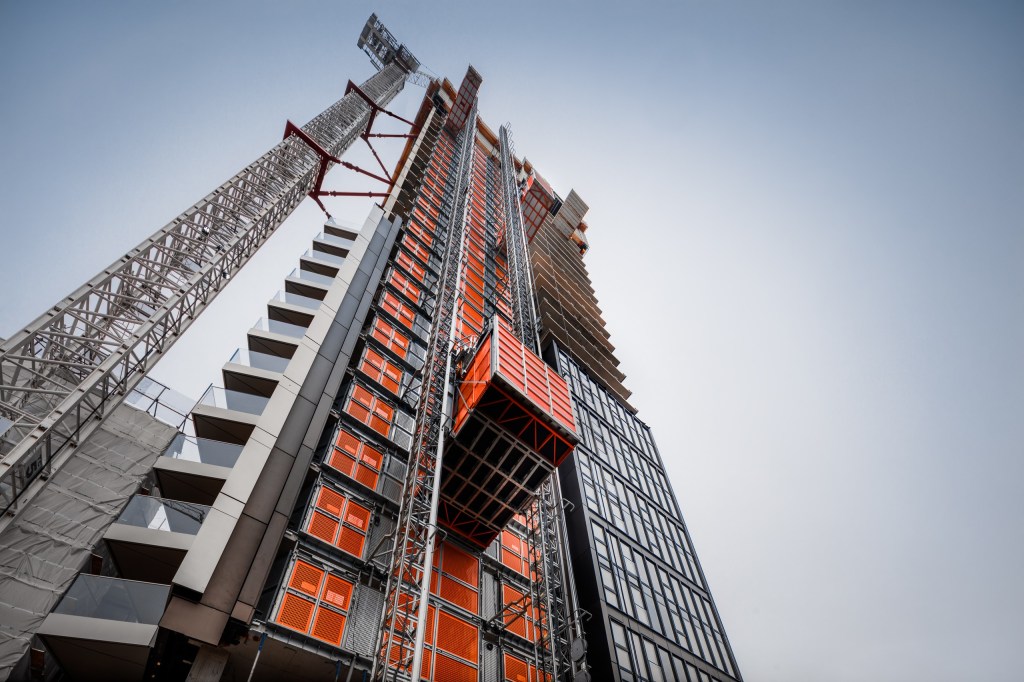
Houston, April 15, 2026.- The economic landscape of the Americas is undergoing a fundamental transformation. In tier-one hubs like New York, Miami, and Austin, the “land-to-value” ratio has reached a tipping point. As urban land prices skyrocket, the horizontal spread is no longer a viable financial model. The future is indisputably vertical.
However, as we push further into the clouds, the complexity of the project doesn’t just grow—it scales exponentially. For a Sales Director in the construction sector, our job is to move beyond selling hardware; we must provide the logistical intelligence that ensures these vertical marvels remain profitable.
The Logistical Friction of Height
In high-rise construction, the “Critical Path” is often dictated by the efficiency of the Vertical Transportation System (VTS). Traditional hoisting methods often become the primary bottleneck. When thousands of workers and tons of materials need to reach the 60th floor, any inefficiency in the cycle time cascades into massive delays.
The cost of a stalled site in a market like Manhattan can reach hundreds of thousands of dollars per day. This is where automation and intelligent hoisting transition from “premium features” to “operational necessities.”
1. Integration of Automated Dispatching
Modern construction hoists are no longer simple mechanical lifts. By implementing intelligent dispatching algorithms—similar to those used in finished permanent elevators—we can optimize the “wait-to-ride” ratio.
- The Impact: Automation reduces “ghost stops” and ensures that the highest-priority loads (whether personnel or critical path materials) are moved first.
- The Data: We are seeing a 15% to 20% reduction in total project delivery times specifically linked to optimized vertical flow.
2. Predictive Maintenance and IoT Connectivity
At Alimak, we understand that the most expensive hoist is the one that isn’t moving. By utilizing Remote Monitoring Systems (RMS), we can track the health of the rack-and-pinion drive units in real-time.
- Proactive vs. Reactive: Instead of waiting for a component failure, sensors alert our technicians to wear patterns before they cause a shutdown. This “zero-downtime” philosophy is what protects the developer’s ROI.
3. BIM Integration for Vertical Logistics
The next frontier is the integration of hoisting data into Building Information Modeling (BIM). By simulating the vertical flow of materials during the pre-construction phase, we can determine the exact number of cars and the optimal speeds required to match the pace of the superstructure’s growth.
The Sales Management Perspective: Selling Time, Not Steel
From a leadership standpoint, my focus across the Americas is to shift the conversation from Capital Expenditure (CAPEX) to Operational Excellence.
When we talk to a General Contractor or a Developer, the value proposition isn’t the lifting capacity of the machine; it’s the compression of the schedule.
- Time-to-Market: If we can shave 15% off the construction timeline, the client begins collecting rent or closing on units months earlier.
- Labor Efficiency: Reducing worker wait times by just 10 minutes per-shift across a 500-person crew results in thousands of recovered man-hours over the life of a project.
Engineering the Future
As we look toward 2026 and beyond, the density of our cities will only increase. To build the future of Miami, Austin, and NYC, we need more than just ambition; we need mechanical precision.
Automated vertical transportation is the key to unlocking the next generation of skyscrapers. At Alimak Group, we are not just witnessing this vertical revolution—we are engineering the systems that make it financially and operationally possible.
Is your current vertical logistics strategy an asset or a liability for your project’s ROI? Let’s discuss how we can optimize your next high-rise development.
Photo: Alimak Group AB