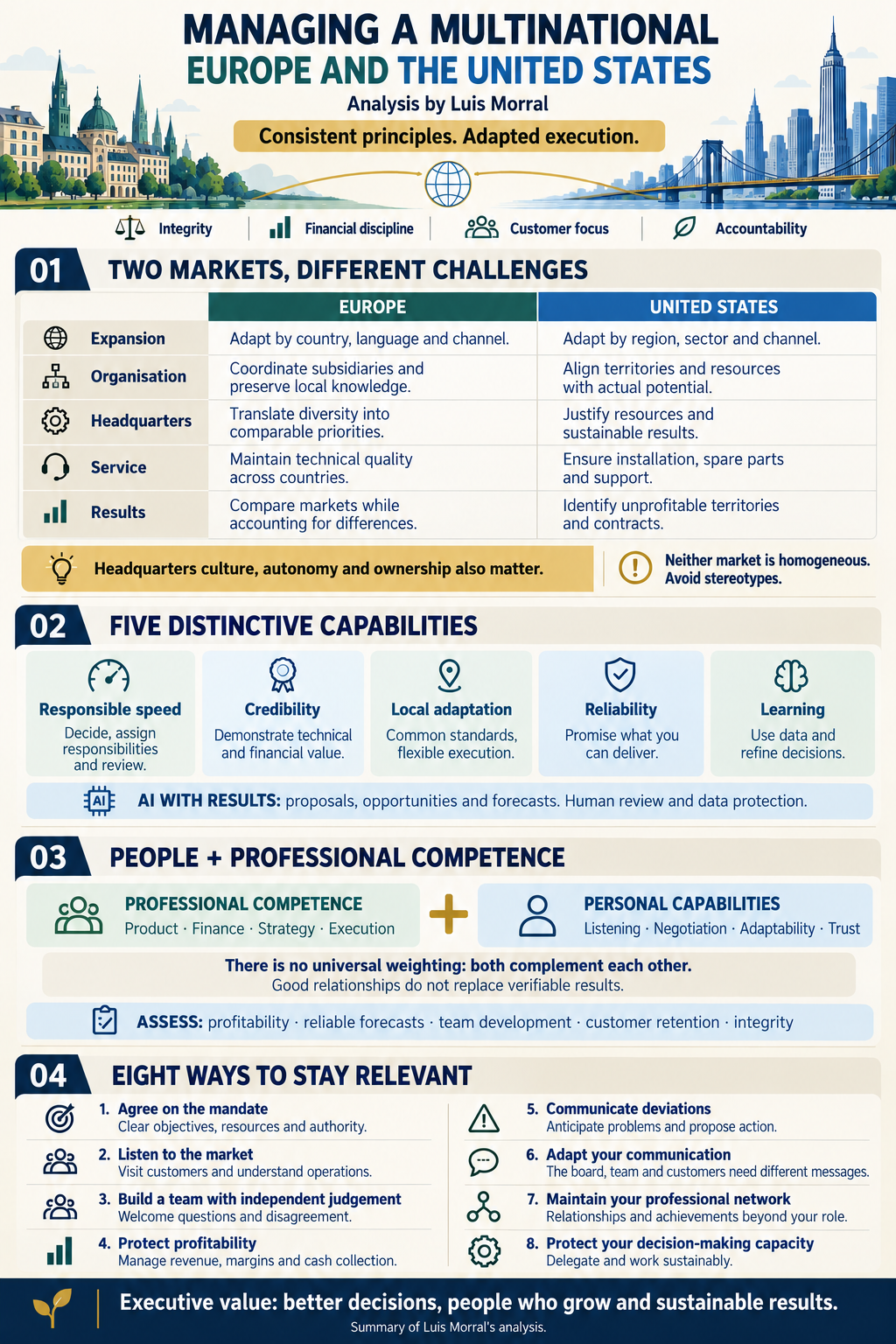
Madrid, November 3, 2026.- Managing a multinational requires an understanding of how decisions are made, how trust is built and what the market expects from our company. When responsibilities span Europe and the United States, automatically transferring a management approach from one region to the other can become a costly mistake.My view is that international executives must maintain consistent principles—integrity, financial discipline, customer focus and accountability—while adapting how they put them into practice. Experience adds value when it helps us interpret a new context, rather than impose familiar answers.
1. Europe and the United States: Differences That Shape Management
One clarification is essential: Europe does not have a single business culture, and the United States is not a uniform market either. Moreover, managing the European subsidiary of a US group is different from running a European company’s operations in the United States. The parent company’s culture, the subsidiary’s autonomy and the ownership structure can matter as much as the country itself.
The clearest structural difference lies in market integration. The OECD highlights that Europe’s internal barriers limit economies of scale and hinder the movement of services, capital and talent. This means that European expansion requires adaptation at the national level, even when businesses share a brand or product portfolio. This evidence primarily concerns the European Union; it should not be applied without qualification to the United Kingdom or Switzerland.
From an operational perspective, I propose the following framework:
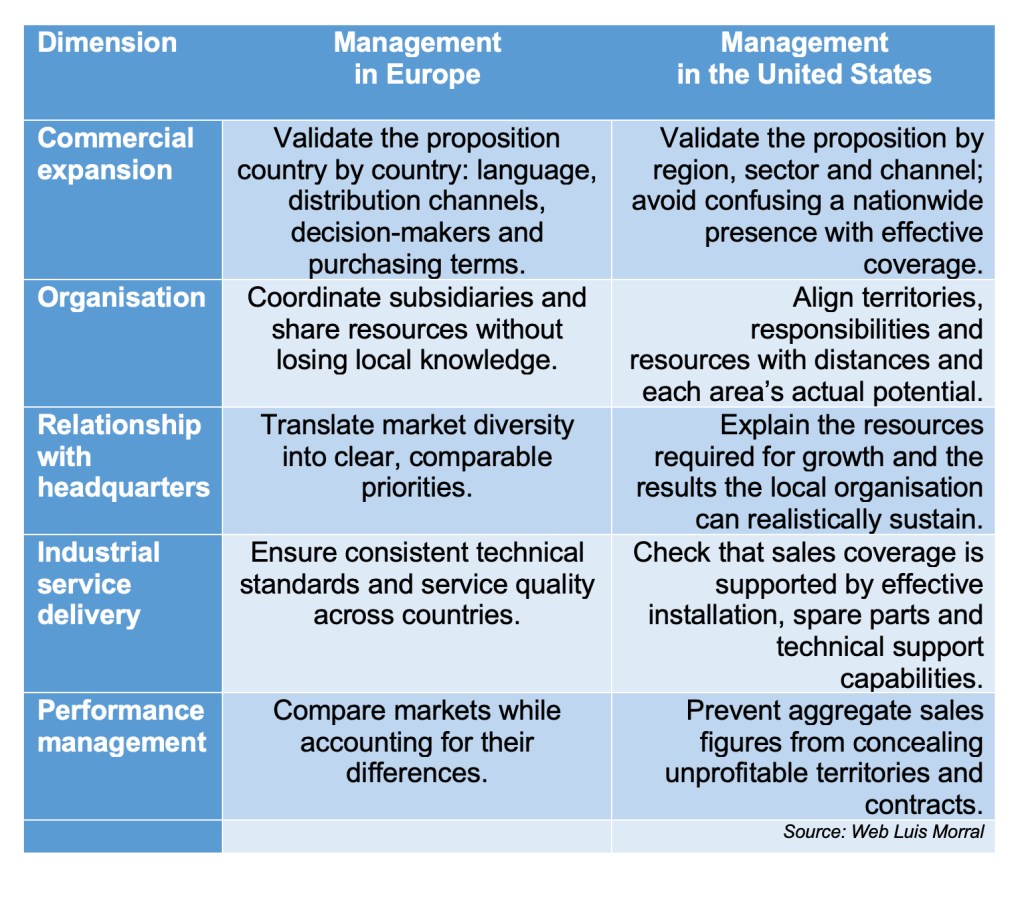
This table is a management guide, not a classification of European and American personalities. We should also question the assumption that the United States always moves quickly while Europe always seeks consensus. An American family-owned business can be highly cautious; a European company backed by an investment fund can demand immediate change. Before adapting a management style to a country, executives need to understand who makes decisions, what information they use and which incentives influence them.
2. Which Distinctive Qualities Matter Today?
Debating which model is superior is less useful than identifying the capabilities each organisation needs to develop.
The OECD documents US advantages in business scale and the use of digital technologies, alongside European difficulties in translating innovation and investment into productivity. These are aggregate differences: they do not mean that every American company is better managed than every European one.
For an industrial multinational, I consider five capabilities particularly important:
- Speed with accountability. Make decisions promptly, specifying who decides, what risk is accepted and when the outcome will be reviewed.
- Technical and financial credibility. Explain how a solution improves productivity, reduces downtime or lowers the customer’s total cost.
- Local adaptation. Maintain common standards while allowing teams to adapt execution to their markets.
- Reliability. Align commercial promises with supply and service capabilities.
- Continuous learning. Reassess decisions when conditions change and use data to identify mistakes.
Artificial intelligence should be introduced with the same practical approach. I recommend starting with applications whose value can be verified: preparing proposals, analysing opportunities or identifying deviations in forecasts. Its value should be measured through tangible improvements, supported by human review and protection of customer information.
In machinery and construction, a technologically advanced proposition loses credibility if the company cannot deliver on time or respond to a breakdown. Commercial innovation and operational capabilities must develop together.
3. Do Personal Qualities Matter More Than Professional Competence?
The evidence-based answer is that there is insufficient evidence to claim that personal qualities always matter more. Separating the two is also difficult: listening, negotiating and managing conflict are personal capabilities that form part of professional competence.
A meta-analysis by Verbeke, Dietz and Verwaal, published in 2011, identified significant associations between sales performance and selling-related knowledge, adaptability, cognitive ability and work engagement. It also found a negative relationship with role ambiguity. The study examines salespeople and evidence from 1982 to 2008; it does not establish a current, universal formula for selecting multinational sales directors.
Meanwhile, The Demand for Executive Skills identifies growing demand for social skills in senior executive recruitment. This shows what companies seek, but it does not, by itself, demonstrate that those skills explain performance better than knowledge or execution capabilities.
My interpretation for sales leadership is this: professional competence enables sound decisions; personal capabilities help ensure those decisions are understood and implemented.
An executive may understand the product and the financials thoroughly yet fail because they do not listen to their team. Another may build excellent relationships while eroding margins through discounts, optimistic forecasts or unrealistic commitments.
We must also distinguish interpersonal skills from personal affinity. A good relationship with headquarters can facilitate access to resources, but it does not prove the quality of management. Trust needs to rest on verifiable results and behaviour.
When assessing a sales director, I would consider the following together:
- Profitability and revenue quality, alongside growth.
- Forecast reliability and the ability to anticipate problems.
- Team development and coordination with operations and finance.
- Customer retention and delivery against commitments.
- Integrity when communicating results, risks and mistakes.
I would not assign universal percentages to “personality” and “knowledge”. I would examine the requirements of the role and the evidence each candidate provides.
4. Recommendations for Remaining Effective and Relevant as an International Executive
Agree on the mandate before accelerating. Growing the business, restoring margins, entering a market and restructuring a subsidiary are different objectives. Executives need explicit priorities, resources and authority that match what they are expected to deliver.
Listen directly to the market. During the first few months, visit customers, accompany salespeople and get to know the technical team. Reports from headquarters should be checked against operational realities.
Build a local team capable of independent judgement. A strong local manager must be able to challenge decisions. Surrounding ourselves only with people who confirm our views reduces our ability to detect mistakes.
Manage revenue, margins and cash collection together. A sale can meet the commercial target while harming the business. I also recommend reviewing service costs, discounts, warranties and committed resources.
Communicate deviations early. Trust with headquarters is protected by explaining what has changed, what impact it has and what action is proposed. Delaying bad news narrows the available options.
Adapt communication to the audience. The board needs priorities and risks; the team needs decisions and support; the customer needs clear commitments. International leadership includes knowing how to translate between those three levels.
Maintain a professional network independent of your position. Industry relationships and up-to-date knowledge support employability. Keep a record of verifiable achievements while respecting business confidentiality.
Protect your decision-making capacity. Delegation, well-planned travel and sustainable habits are part of executive responsibility. An organisation that constantly depends on one person’s availability needs to rethink its structure.
My approach to leadership on both sides of the Atlantic is to combine clear standards with enough flexibility to understand each market. An international executive’s value is reflected in the decisions they improve, the people they develop and the lasting capabilities they build to sustain results.
- Managing a Multinational in Europe and the United States: Results, People and Adaptability
- He rise of AI-Agent networks on the interconnected job site

- Solving the 2026 Talent Deficit

- The Vertical Nervous System: Transforming Construction Hoists from Cost Centers to Data Assets

- The Great Re-Shoring: Why Monterrey is the New Chicago

- The Vertical Shift: Optimizing Megacity Development through Automated Transportation Systems

- The Most Expensive Minute on a Jobsite

- Safety and Productivity on U.S. Construction Sites Regulation, Vertical Access Technologies, and Risk control

- Evolution of the U.S. Construction Market: Public Works vs. Private Cycles, Financing and the Medium Term Outlook



I’m interested in your comment. Thank you: