Houston, August 28, 2026.- For the past decade, digitalization in the construction sector has followed a predictable roadmap: deploy a cloud-based project management platform, equip field teams with tablets, connect heavy machinery via basic telematics, and aggregate the resulting data into an executive dashboard.
While this centralized approach improved visibility, it introduced a new bottleneck for General Managers and CEOs: cognitive overload. Modern mega-projects now generate millions of data points every day, but executives and project directors are still forced to manually synthesize this information to make critical decisions. We have built connected job sites, yet we are still relying on human latency to solve operational friction.
As we move through 2026, a fundamental paradigm shift is underway. The industry is moving away from passive data collection toward autonomous coordination. The future of project execution belongs to AI-Agent Networks—decentralized ecosystems of specialized software agents that don’t just display information, but actively negotiate, predict, and solve logistics, engineering, and financial anomalies in real-time.
For construction executives, understanding this shift is no longer a matter of forward-looking R&D. It is a critical imperative for protecting margins, managing liability, and scaling operational capacity in an increasingly volatile market.
What is an AI-Agent Network?
To lead this transformation, executive management must understand the distinction between the predictive algorithms of the past and the agentic workflows of 2026.
Traditional construction software is reactive: a superintendent inputs a delay, and the schedule updates. An AI Agent, by contrast, is proactive and autonomous. It possesses an objective, continuously analyzes its assigned domain, evaluates alternatives, and takes direct action within predefined parameters.
An AI-Agent Network occurs when these specialized entities communicate directly with one another without requiring constant human intervention. On a modern interconnected job site, this looks like a digital ecosystem where multiple independent agents coordinate seamlessly. When these systems operate concurrently, they form an autonomous operational layer that runs beneath the physical project, constantly smoothing out inefficiencies before they impact the bottom line.
Value Generation: The Executive Financial Impact
For a General Manager, the justification for investing in AI-agent networks lies entirely in contract protection, risk mitigation, and structural overhead efficiency.
1. Eradicating Dynamic Bottlenecks in Vertical and Horizontal Logistics
On high-rise or massive industrial projects, material flow is a primary point of failure. If an unexpected delivery arrives when the primary tower cranes or material hoists are booked for a major concrete pour, the job site stalls, racking up costly labor hours.
An interconnected Logistics Agent continuously cross-references real-time GPS data from incoming supply trucks, weather forecasts, and crane utilization logs. If a delay is detected on the highway, the agent negotiates directly with the site’s scheduling system to adjust the hoist queue, re-route the delivery vehicle to an alternative holding yard, and notify the subcontractors via their mobile devices—all in a matter of seconds, without requiring a single phone call from the superintendent.
2. Instantaneous Clash Resolution and Change Management
Engineering changes during the execution phase are historically slow and litigious. When an MEP (Mechanical, Electrical, Plumbing) clash is discovered in the field, work stops, an RFI (Request for Information) is generated, engineers review it, and a change order is drafted. This process regularly takes days or weeks.
In an agentic environment, an Engineering Agent scanning the site via automated drone or laser data detects the variance against the digital twin immediately. It communicates with the Design Agent to run a structural simulation, finds an alternative routing that complies with building codes, updates the central BIM model, and submits the revised layout to the project director for approval—reducing an error-correction loop from 14 days to 14 minutes.
3. Automated Capital Optimization via Smart Contracts
Cash flow management is the lifeblood of any general contractor. Financial Agents tied to on-site computer vision and IoT sensors can verify milestones autonomously.
Once the Engineering Agent confirms that a structural steel assembly has been correctly erected and passed safety checks, the Financial Agent verifies the contractual clause and automatically initiates payment to the fabricator via integrated smart contracts. This slashes accounts payable overhead, eliminates payment disputes, and allows general contractors to negotiate aggressive early-payment discounts with suppliers.
The Strategic Blueprint for GMs and CEOs
Deploying autonomous agent networks requires a shift in executive leadership strategy. You are no longer purchasing single-point software licenses; you are designing an organizational operating system.
Phase 1: Mandate Interoperability as a Contractual Requirement
The greatest barrier to AI-agent networks is fragmented data. If your structural engineer uses one isolated ecosystem, your logistics provider uses another, and your machinery suppliers run closed telematics, your agents cannot communicate.
As an executive, you must establish a strict Common Data Environment (CDE) framework. Mandate that every vendor, subcontractor, and technology partner provides open, bidirectional API access. If a vendor cannot or will not share data seamlessly, they should be disqualified from bidding on your mega-projects.
Phase 2: Define the “Human-in-the-Loop” Thresholds
Autonomous operations do not mean abdication of executive control. GMs must establish clear financial and operational boundaries for their agent networks. For example:
- Below $10,000: The agents can autonomously re-route materials, authorize minor field changes, and adjust daily schedules.
- Between $10,000 and $50,000: The agents synthesize the optimal solution and present three actionable alternatives to the Project Director for single-click approval.
- Above $50,000: The system flags the anomaly as a high-level risk and halts relevant sub-workflows until an executive review occurs.
Phase 3: Transition from “Firefighting” to Exception Management
The ultimate organizational impact of agent networks is a cultural shift. Traditionally, project managers spend 80% of their time “firefighting”—reacting to immediate, daily crises. By delegating routine logistical and administrative coordination to an autonomous network, your highly compensated project directors are freed to focus entirely on macro-strategy, client relationships, and complex safety risk management.
The Competitive Edge in 2026
The construction companies scaling successfully today are not those building with fundamentally different materials or tools; they are those managing project risk with superior speed and intelligence.
Relying on human administrative speed to manage the chaotic variables of a multi-million dollar job site is a legacy approach that erodes profit margins. AI-agent networks turn data from a passive historical record into a live, predictive shield.
For the modern General Manager, the decision is clear: implement an autonomous coordination layer today, or watch your organization get out-paced, out-bid, and out-executed by competitors who can adapt to changing field realities in real time.
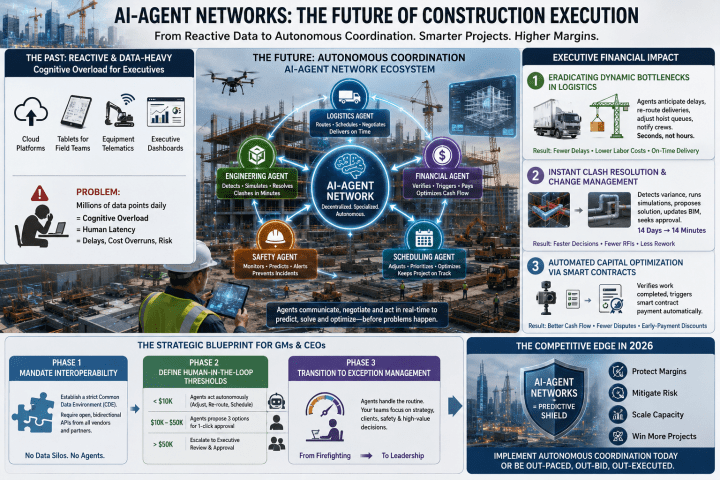
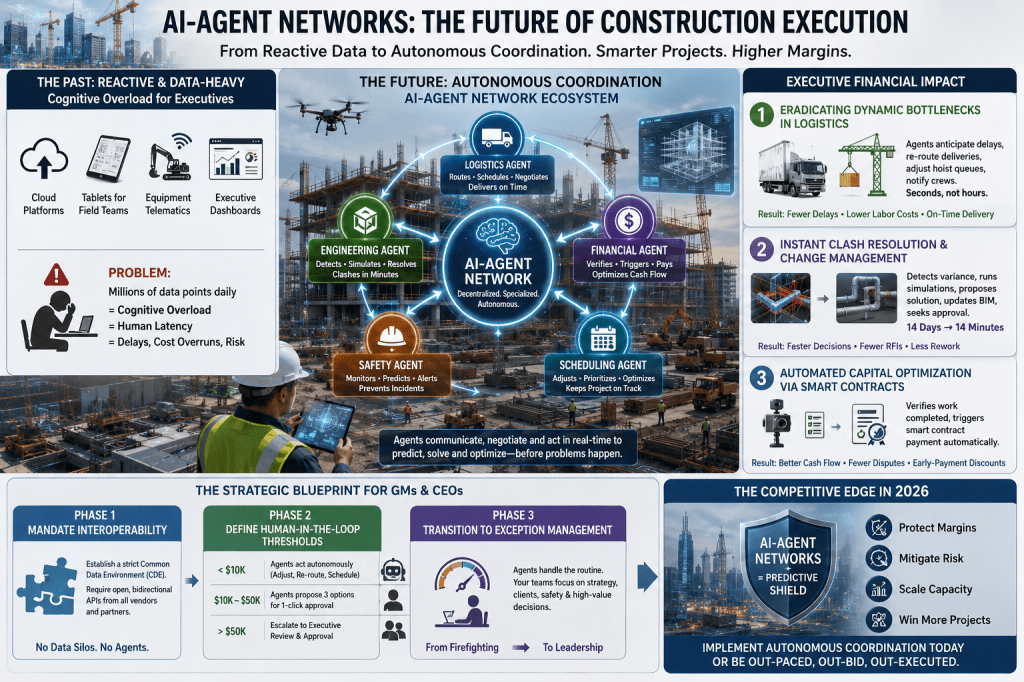
Infographic: Generated with ChatGPT


You must be logged in to post a comment.