

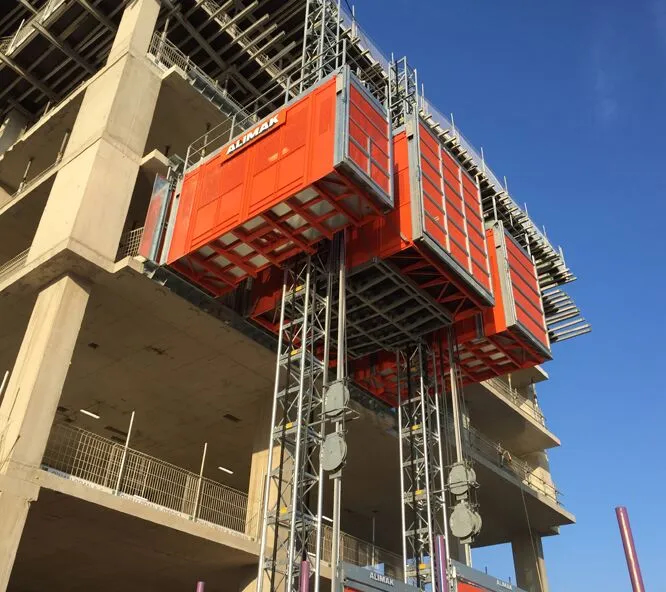
Houston, March 16, 2026. In the high-stakes environment of modern skyscraper construction across the Americas, we often mistake motion for progress, yet in my experience at the helm of vertical access strategy, I’ve realized that the most expensive minute on a jobsite is the one spent waiting for a hoist that isn’t there. For decades, the construction hoist has been viewed merely as a functional necessity, a rugged steel box designed to move men and materials from the ground to the deck but this traditional perspective is rapidly becoming obsolete.
To truly master the logistics of a massive project, we must stop seeing the hoist as just a tool and start treating it as a critical data point within a larger, interconnected digital ecosystem. This shift begins with the deep integration of Building Information Modeling (BIM) into the very early stages of vertical access planning, moving beyond simple 3D visualization into the realms of 4D scheduling and 5D cost estimation.
When we integrate vertical access into a BIM framework, we move away from “best-guess” placements toward precision-engineered logistics. By utilizing a digital twin of the structure, we can perform advanced clash detection that accounts not just for the permanent works, but for the temporary infrastructure that sustains them. This means we can identify, months before a single bolt is turned, whether a hoist tie-in will interfere with a curtain wall bracket or if a landing gate configuration creates a bottleneck for specialized MEP equipment delivery.
By simulating the “vertical commute” of thousands of workers within the BIM environment, we can calculate peak flow demands with mathematical certainty. We no longer ask if we have enough hoists; we know exactly how many cycles are required to clear the morning rush and how the placement of specific cars optimizes the path to the most labor-intensive floors.
This level of intelligent planning extends into the temporal dimension through 4D BIM, where the hoist’s lifecycle is synced perfectly with the building’s growth. We can visualize the exact moment a hoist needs to “jump” to the next level or when a high-speed car should be decommissioned to allow for the final closure of the building envelope. This synchronization minimizes the “idle time” of the equipment and, more importantly, the idle time of the workforce.
When the hoist is treated as a data point, every trip it makes becomes a metric for project health. We can analyze cycle times, load weights, and energy consumption patterns to refine our logistical strategy in real-time. If the data shows a 15% increase in wait times on the 40th floor, the BIM-integrated logistics plan allows us to adjust scheduling or reallocate cars before that delay compounds into a week-long setback for the following trades
In today’s connected jobsite, the hoist is no longer just a lifting device. It is a sensor within the construction ecosystem, continuously generating data on cycle times, peak usage periods, and vertical traffic patterns. Equipped with advanced visualization and monitoring systems, modern hoists can also enhance safety oversight by helping identify potential risks and unsafe conditions before they escalate.
Ultimately, the goal of this technical synergy is to redefine the concept of jobsite efficiency. In a traditional mindset, speed is the only variable that matters—faster motors, faster doors. However, true efficiency is born from intelligent planning and the reduction of friction. A hoist moving at four meters per second is useless if it arrives at a floor where the materials aren’t ready or the workers are already over-capacity. By leveraging BIM to optimize placement and predictive scheduling, we ensure that the right resources are at the right height at the precisely right moment. We are no longer just moving boxes; we are managing the pulse of the construction site.
This data-driven approach transforms vertical access from a peripheral service into a core driver of project ROI, proving that the most successful projects are not those that work the hardest, but those that plan the most intelligently.
 LUÍS MORRAL, Sales Director - Americas Construction at ALIMAK GROUP
You must be logged in to post a comment.